
I work with business owners across the architecture + design industry every day and a problem I see regularly is that most can’t tell me their numbers.
If you don't know your numbers you're making business decisions based on guesses, which is how you end up working really hard and still wondering why you're not making any money (sound familiar??!).
There are lots of metrics and data you should be tracking as a business owner, but there are three that are critical and that you should know off the top of your head. Here’s what they are…
1: Your average project value
This is the average amount of revenue you generate per project.
To work it out take your total revenue from the last 12 months and divide it by the number of projects you completed.
So if you did 10 projects and generated $1,000,000, your average project value is $100,000. If you did 20 projects and generated $1,000,000, your average project value is $50,000.
Why this number matters is because it tells you how many projects you need to take on to hit your revenue goals.
If your goal is $2 million in revenue and your average project value is $100,000 you need to sign 20 projects. But if your average project value is $500,000 you only need to sign 4.
Without knowing this number you will end up overworked on small jobs when you should be raising prices and taking on fewer bigger ones.
If your average project value has stayed flat for years while your costs have gone up, that's also a problem. Your pricing should be increasing with the market, not sitting still while everything around you gets more expensive.
2: Your gross and net margins
These are two different numbers that tell you different things and you need to know both.
Gross margin is the percentage of revenue you keep after project related costs (consultants, materials, subcontractors, samples i.e. costs tied specifically to delivering that project).
Formula: (Revenue minus project/direct costs) ÷ revenue x 100.
So $100k revenue minus $70k direct costs = 30% gross margin.
Gross margin tells you if your work itself is profitable.
Because A+D work is largely service and advice based your gross margins should be quite high as you shouldn't have a lot of costs associated with delivering that work.
Net margin is the percentage of revenue you keep after ALL costs including overheads (i.e. salaries, rent, software, marketing, vehicles, insurance).
Formula: (Revenue minus all costs) ÷ revenue x 100.
So $1M revenue minus $850k total costs = 15% net margin.
Net margin tells you if the business is profitable.
You can have great gross margin and terrible net margin if your overheads are too high.
If gross margin is bad the problem is in your pricing, scope or project costs (this probably won't be the issue most of you have). If gross is fine but net is bad the problem is your overheads (this is more likely for many of you who have expensive fixed overheads like rent or too many under utilised employees).
I generally am more interested in net margin over gross as this tells you the most about the financial health of your business.
3: Your conversion rate
This is the percentage of initial consultations or meetings that turn into signed, paying clients (i.e. they accept your proposal and pay the deposit or sign the contract).
To work it out, take the number of clients who signed on and divide that by the number of qualified leads or initial meetings you had in the last 12 months. Times by 100.
So if you had 30 qualified meetings and 12 of them signed on, your conversion rate is 40% (which isn't great).
This number tells you whether your sales process is actually working. If you're meeting with lots of potential clients but no one is signing on you have a sales problem. Knowing this means you can now look at whether the issue is with your initial consult, your proposal or your follow up.
A good conversion rate in this industry is 50% or higher. If you're qualifying leads before you meet with them (i.e. you have a proper screening process and/or you charge for your initial consultations) it should be closer to 70-80%.
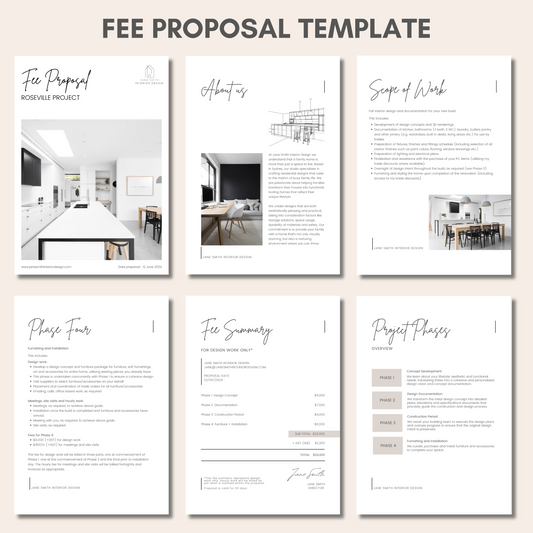
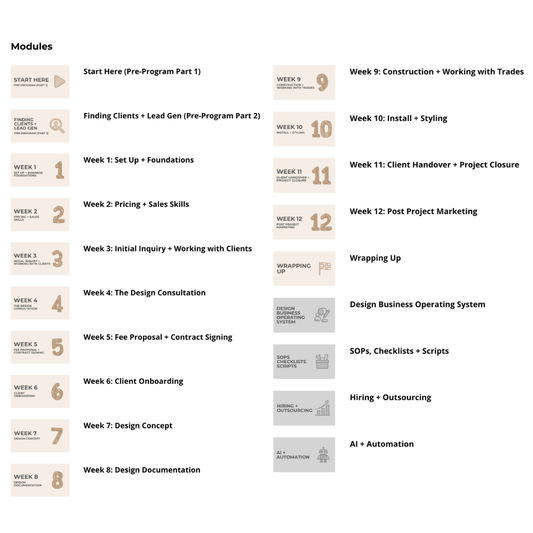
I used to close around 85-90% of my consultations into larger projects because I had a specific sales motion that I would run that I perfected over many years. I unpack that in my Bootcamp program if you want to learn it.
If your conversion is below 30% something is broken in your sales process. Usually it's related to a poorly run initial design consult, your proposal isn't good enough or you're being shopped around against multiple competitors (which means you’ve positioned yourself as a commodity instead of “the” business they need to work with, which is a brand issue).
Why these three numbers?
Each of these numbers tells you a different thing about your business.
➡️ Average project value tells you whether you're charging enough and taking on the right size of work.
➡️ Net margin tells you about the financial health of your business.
➡️ Conversion rate tells you whether your sales process is working.
Once you know all three you can see exactly which levers you need to pull to grow your business. Sometimes it's getting more leads in your pipeline, sometimes it's converting more by improving your sales motion and sometimes it's about raising prices or reducing costs.
Without these numbers you're just guessing what is happening (and most people guess wrong). They assume they need more leads when they actually need to fix conversion or they assume they need to raise prices when they actually need to fix their margin.
So I would encourage you to sit down today and work these out. It will completely change how you make decisions in your business going forward.
Need help? Join Bootcampand we will address these issues step by step.