
I had an email from a designer this week about a fee proposal she is putting together for a large residential project.
She has been working in the industry for 45 years and runs a studio doing high-end residential work. She's been approached to design a new 16,000 sqft family home in the UK with an estimated interiors spend of £3.5 million.
The client asked her to quote for design work, involvement during construction, liaison with architects and consultants, site visits and potentially some procurement.
She told me she had estimated that the project would take about six months and calculated that at her normal day rate her fee would come to £240,000.
Her question to me was whether £240,000 seemed like the right fee and how she should present it.
Here was my thinking and ideas back to her…
The first thing I told her was that I would be very careful about offering £240,000 as an all inclusive design fee. To me it felt like that number was plucked out of nowhere rather than be attached to the scope she had been provided.
Even though the design itself might take six months to produce, on a house of this scale the project itself will almost certainly continue for considerably longer.
Once construction starts there will be site questions, meetings, revisions and things that need to be resolved as the build progresses. There will probably also be things nobody can predict right now.
That's where I think designers can get themselves into trouble with one large fixed fee.
If the proposal says £240,000 as one fixed fee, what has actually been allowed for?
For example:
- Does that include two site visits a month or two site visits a week?
- Does it include every consultant meeting?
- Every design change?
- Every builder question?
- Does it still apply if construction takes 18 months longer than expected?
If none of that has been defined, the designer has taken on a lot of risk and has effectively sold the client access to her for however long the project takes.
The designer shared the brief from the client with me and he had already separated what he wanted into different types of work.
- Firstly, he wanted a complete design scheme
- Secondly, he wanted her involvement during construction
- Thirdly, he wanted an arrangement around procurement
I advised the designer to use that structure rather than giving him one large number for everything.
I advised breaking the proposal into phases, each with a scope of work, deliverables and fee attached. Then I would look at the total. She may find that £240,000 is right but she may find that once she allocates a fee across everything she is agreeing to she has under or overpriced it.
To me that’s a much more useful exercise than deciding that £240,000 feels like a reasonable number and hoping the project goes as expected.
When pricing the construction stage I would also be very careful.
I would not offer unlimited site visits, consultant liaison, design changes and general construction support until the house is finished as part of one fixed fee. I would define what has been allowed for and explain what that allowance is based on.
For example, that might mean a set number of site visits each month, a defined period of construction stage involvement or a monthly retainer once construction starts.
There are different ways to structure it, but there needs to be some mechanism that allows the fee to change if the project extends significantly or the level of involvement changes.
The most important thing is that each part of the fee properly covers what she is committing to and leaves room to add more scope and fee if the project changes or extends.
Pricing this way gives the client a clear understanding of what they are likely to spend but means the designer has not effectively sold unlimited access to her studio from now until the house is finished.
Break down all fee proposals into phases
My preference with any fee proposal over about $20,000 (or equivalent) is to break it down into phases. I like this for a few reasons.
The first is that it is more palatable for a client. An all inclusive fee of £240,000 seems like a huge amount and can be a shock, even to wealthy clients. But a fee that is unpacked in phases feels very different (even if the total ends up being the same). It turns your fee proposal into a phased journey and allows you to give the full picture of what’s involved in delivering a project of this scale. It’s a sales psychology trick that will help you convert more clients, trust me :)
The second is that it gives both parties natural exit points. If a phase isn't going well, either the client or the designer can pause before the next phase starts. This builds in genuine decision points at the end of each phase so neither party ends up trapped in a project that isn't working.
The third is that it gives room to adjust scope. If the concept comes back and the client realises he can't afford the full build, the designer can scale back what happens next without unwinding a fee that already covered everything.
The fourth is that the designer gets paid as she goes. Each phase has its own fee and I teach all designers that work with me to charge 50% of that phase fee at the start of the phase and 50% at the end. This avoids having to chase progress payments and ties fees to work actually being done at the time. It also helps you manage your cash flow.
And finally it positions the designer as a professional who has done this before. An all inclusive fee looks like the designer has plucked a number out of nowhere. A phased proposal shows the client that she understands the shape of the project, where the risks sit and how to structure the work so both parties are protected. That difference alone can be enough to win the job.
So I wouldn't start with £240,000 and ask whether it feels right. I would start with the work that needs doing and break that into phases. I would then decide exactly what’s included in each phase and price those individually (tracking your hours helps you do this accurately, but this is a whole other topic!). The fee should come out of the scope of work, the hours you will spend on it combined with the value being provided to the project.
Breaking the fee down gives the client a much clearer proposal and gives the designer far more protection if the project changes or becomes more involved than was expected at the start.
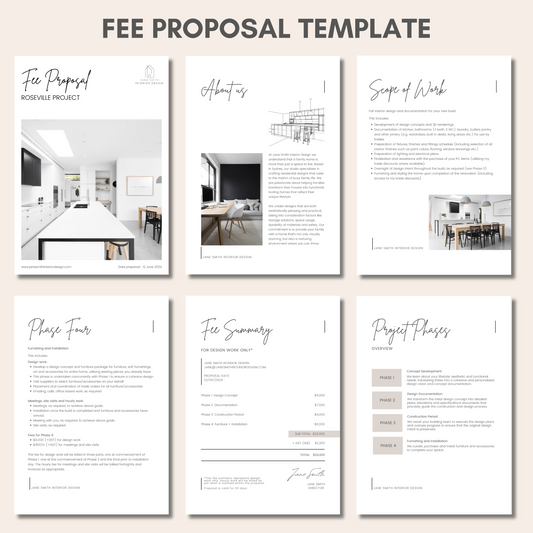
If your proposal needs work my Fee Proposal Template comes with completed examples showing how I break projects into phases, define the scope and structure the fees.
I had an email from a different designer this week saying that she sent out my fee proposal template to two clients last week and closed both of them. So if you want more clients, this proposal works :)