
Today I’m going to share the real numbers that designers at the top of our industry are charging. Once you see what a high end job costs and demands in fees your own pricing is going to feel very different!!
A few things to know about these numbers before we get into it.
The numbers I’m sharing are for interiors only, not the cost of building the house. I'm talking about an interior fit out of a new build or a full reno/remodel of an older house. So when it says a $5 million build, that means $5 million spent on the interiors only (e.g. kitchen, bathrooms, joinery/millwork, furniture, artwork etc.), not on the full project build cost. Yes, this is really the budget that clients at the top end have for this!
What top designers are charging
Here’s what to take notice of first…the fees these designers charge for concept alone are more than what most of you charge for a full project.

Here's what else to notice...the interiors budget is probably much, much higher than your projects (we will come back to how you get to this below).
The reason the budgets are so high is because designers at the top end can't deliver their quality of interiors for less than that. If you're wondering who has the money for this sort of work, their clients are generally in finance, investment banking, have their own successful business or they are from 'high society' families, i.e. generational wealth. Clients at this end of the market demand a lot because they are paying a lot.
But to charge fees like this and work for clients like this you have to have an exceptional level of design skill, a lot of experience AND a brand that attracts those clients to you. Most designers at the top end don't need to chase clients. Clients come to them.
Now let's compare those numbers to what many of you charge
You do the same sort of work and tasks as the top end designers but you're taking on clients with tiny budgets so can't charge anywhere near the same level of fees.

Look at those two tables side by side. You're doing concept, documentation, construction administration, FF&E procurement. You’ve got the same phases and the same deliverables and the same type of work. But the fee gap between a $500K project and a $5M project is enormous and most of that gap comes down to the size of the client's budget and the type of project, not the complexity of your actual day to day work (i.e. you are doing the same sort of work as them).
How you climb from where you are now
You don't get from $500K builds to $5M builds in one leap. You climb the pricing ladder one rung at a time by making deliberate decisions about the types of projects you will accept and the types of clients you will work for.
This is how all the top designers you admire have got there too.

Note: these are example prices based on designers I speak with daily. Pricing will of course vary depending on where you live and the type of projects you work on.
Step 1: Stop taking $500K projects
In the current economy it's impossible to deliver high quality, full service interiors for under $1 million. By the time you've done a custom kitchen, some bathrooms, custom joinery/millwork and furniture/accessories you're looking at a minimum of $1 million on interiors, often more.
A lot of sub $1 million projects will be compromised before you even start and you end up with clients wanting a $1 million result on half the budget. This is a tough situation for you.
So your first step is to move your baseline to $1 million projects and above and your business will change overnight. You will be doing the same work as you currently do but for almost double the fee.
Step 2: Build proof at $1 million
Use your $1 million projects to build a portfolio that gets you to the next rung.
To do this you have to do an exceptional job and make your clients happy so they tell more friends at their level about you. Wealthy clients have wealthy friends and they will tell their friends about you if you do a good job. You also need to get the project professionally photographed, publish it, submit it to awards and post it on your social media.
Every $1 million project becomes the social proof that makes your next client feel safe about spending their money with you. Your finished projects are how you sell the next ones, so treat documenting them as part of that job.
Step 3: Move to $3 million projects
Once you've done a number of $1 million projects and they feel normal, you can move to the next rung ($2-3 million projects).
By this point you've got some strong projects behind you, you're feeling more confident in what you do and you've learned how to work on larger projects by building better systems and processes. You're also learning more about the expectations and lifestyle of clients at the multi-million price bracket, which makes jumping to the next rung of clients feel less daunting.
Look again at what this does to your numbers. A $3 million build is around $200K in fees. That's 4-6x what you were making on the $500K jobs and you're still doing the same sort of daily tasks.
Step 4: Move to the top of the table
This is where the designers you admire are working. They got there by climbing the same project pricing ladder, one rung at a time. They have the same career as you, but they point that career at bigger and better quality projects over time. They also have the confidence to charge properly for the work they do and to improve their design skills and brand constantly.
(By the way, lots of them still feel like imposters, even at the top end. This is normal as you climb each rung of the ladder!)
One important thing!!
As you move up the ladder, each rung demands more of you and you have to be honest about whether you have the skills to climb it.
The designers working on $5 million builds have exceptional design skills and a brand that backs up their fees. There are lots of very good designers, but there aren't many that can command $300K in design fees and that's ok. A business built on $1 million projects at $57-78K in fees can still be a very good business.
The point is you need to get off the bottom rung of the ladder. Stop taking projects where you're doing the same amount of work for a fraction of the fee. Move your minimum project budget up one rung and watch what happens to your revenue, your stress levels and the quality of clients you're working with.
By the way, you may be wondering how I know the numbers I’m sharing here given that the industry is VERY secretive about this stuff. Well it’s because I talk with a lot of designers and behind closed doors many of them are happy to discuss their numbers with me. :)
But if you want confirmation that I’m not making these numbers up, you’ll find this post from interior designer, Lori Paranjape, very enlightening.
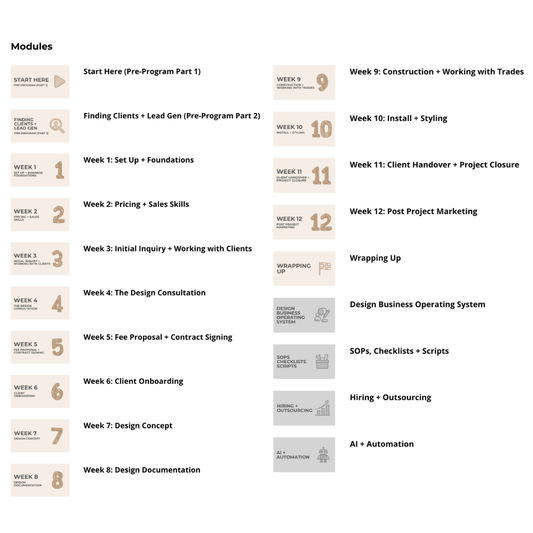
And if you need help with any of this my business course for interior designers is always open and you can start anytime.