
If you want to work on expensive homes, you need to know the local property market almost as well as the agents selling them.
Why?
Because you are advising clients who may be about to spend $500,000, $1 million or several million dollars changing an asset that is often worth many millions itself.
That makes the property market highly relevant to your job as a designer.
So in the areas that you service you should know what renovated homes achieve compared with unrenovated ones. You should know which streets command a premium, what buyers expect at different price points and what types of renovations keep appearing in stronger sales. You should also be watching recent sales constantly. It would be even better if you knew some of the local agents and built relationships with them.
When a client says they are considering spending $1 million to renovate a $4 million house, you can then have a much more intelligent conversation than just asking what style of kitchen they like.
If you know the property market you'll know that three recently renovated homes nearby sold between $6 million and $8 million and the kitchen in those houses all had Gaggenau appliances and a particular layout (or perhaps a butler's pantry). You might also have noticed that each of those houses had a proper fifth bedroom and an additional dedicated office.
In short, you can start to give advice on what would be expected by buyers. If you start talking like this clients will often say "oh we aren't selling, this is our forever home" but I used to always tell my clients to think about resale, even if they weren't planning on selling. You never know when something happens and you have to sell and you want to create an asset that is always easy to sell!
You obviously aren’t going to be giving advice like "Spend $1 million and your house will increase by $2 million."
You are not a valuer and property values depend on far more than interior design. So don't expose yourself to that sort of risk.
But if you're knowledgable about the market you can say things like:
“These are some recent local sales that are worth looking at. Notice the finishes/appliances/look and feel that buyers at this end of the market appear to expect.”
“Before removing that bedroom, I would speak with your agent about how that decision could affect resale as I've noticed that recent sales at your price point always keep the 5th bedroom"
That is a completely different level of advice and it will change how a client sees you.
You stop being a person they might hire to choose tiles, sofas and tapware and become a professional who understands the broader commercial context around the decisions being made.
That matters a lot with sophisticated, high net worth clients.
People who own valuable property are often very interested in the property market. They know what houses around them have sold for and will likely know the properties you're referring to. They know roughly what their home is worth and they probably also already have relationships with agents in the local area.
If you know nothing about the market their house sits within, there is a limit to how commercially useful you can be in those conversations.
Knowing the market is a sales advantage for your business.
Imagine meeting a prospective client and being able to discuss three comparable properties that sold nearby, the standard of renovation buyers are currently paying for and why the level of investment they are considering is not unusual for that type of house.
Compare that with another designer who spends the meeting talking about colour palettes and design aesthetic.
One conversation sounds like somebody who understands an expensive residential asset. The other sounds like somebody who wants to decorate it.
You can also use this knowledge to help clients make better design decisions.
Should they sacrifice a bedroom for a large walk in robe? Should they spend a lot on the second bathroom fixtures? Is adding a butler’s pantry important in this particular suburb? Is the kitchen dramatically below the standard now expected in homes at this price point?
Design decisions shouldn't happen in an economic vacuum.
Your need to understand enough about the client's property, local market and level of investment to ask better questions, make more informed recommendations and recognise when a design decision has consequences beyond how the room looks.
This is all part of acting as a professional consultant (which means you’ll get paid more!). If the way you talk with clients positions you as the person who finds furniture, shops for finishes and makes things look nice, you’re going to struggle to command high fees and win expensive projects.
But knowing something about property is only one tiny part of the equation.
Your whole business then has to match this level of professionalism, which is why I spend so much time teaching designers to improve the commercial side of their business, not just their design skills.
You are helping clients make decisions about what is often their most valuable financial asset. The advice you give, the way you run your business and the fees you charge should reflect the level of responsibility that comes with that.
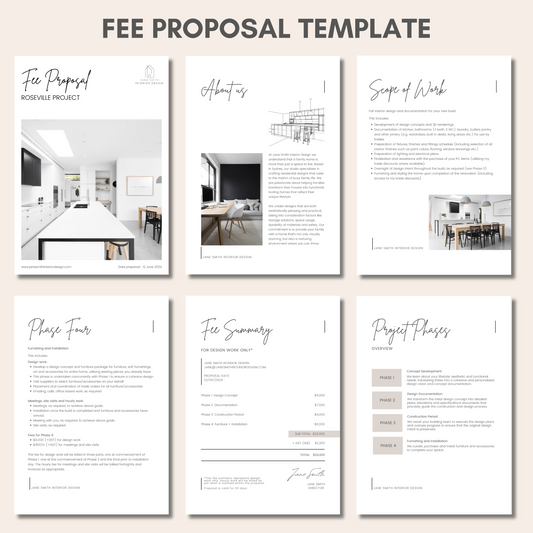
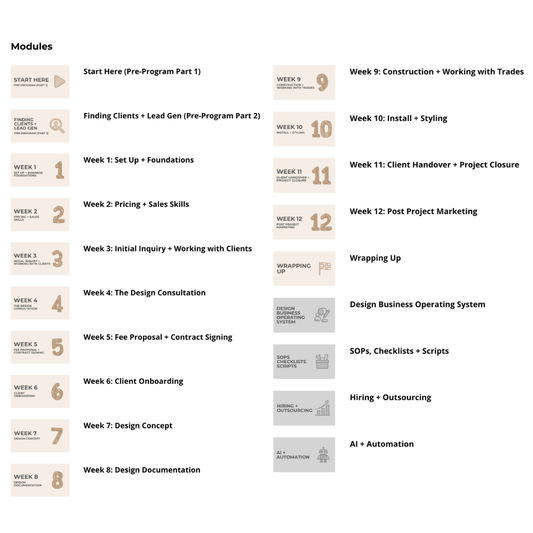
If you need help with this Design Business Bootcamp brings the whole client and business process together, including pricing, proposals, onboarding, approvals, documentation and the systems that support a professional design practice.